
Volume 23 Issue 12
October 2026
A great sign appeared
Rev 12:1
October unfolds as a sacred tapestry woven in honor of the Holy Rosary, a devotion deeply anchored in the Feast of Our Lady of the Rosary on the 7th of October. This enduring tradition is born from a pivotal moment in history when faith altered the course of destiny.
On 7 October 1571, a coalition of European Catholic naval forces sailed into the Gulf of Patras to confront the formidable fleet of the Ottoman Empire. Facing overwhelming odds and immense material disadvantage, Pope Saint Pius V turned to a weapon of spiritual grace. He called upon the faithful across Europe to unite in praying the Rosary, invoking the heavenly intercession of the Blessed Virgin Mary.
Against all human probability, the Christian forces emerged victorious, halting a westward expansion that threatened the very fabric of Europe. In profound gratitude for this miraculous triumph, which he attributed not to the might of arms, but entirely to the power of prayer, Pope Pius V dedicated the 7th of October as the feast of Our Lady of Victory, forever intertwining the month of October with the transformative grace of the Rosary.
The legacy of the Rosary shifted beautifully in 1573 when Pope Gregory XIII renamed the celebration the Feast of the Holy Rosary, the very celebration we know today as the Feast of Our Lady of the Rosary. Though the faithful had kept this feast alive for centuries, it was Pope Leo XIII who expanded its reach by officially declaring October the Month of the Rosary. Drawing strength from the historic victories attributed to this powerful devotion, he issued his 1883 encyclical, Supremi Apostolatus Officio. In it, he passionately called upon Catholics to commit to the daily Rosary for the entire month, seeking divine protection and spiritual fortitude for the Church. For this reason, we urge the global CFC community to include the recitation of the Rosay in their household prayer meetings during the month of October.
This coming November, we will be visiting Lao PDR and Cambodia on a United Nations assignment. In between these two visits, we plan to go on pilgrimage to the Shrine of Our Lady of La Vang in Vietnam. Our Lady of La Vang is a highly revered Marian apparition that took place in 1798 within the remote rainforests of Quang Trị Province, Vietnam.
Fearing the spread of a foreign religion, Emperor Canh Thịnh – the last emperor of the Tay Sơn dynasty who reigned from 1792 until 1802 – issued a strict anti-Catholic edict in 1798. To escape execution, a group of local Catholics sought refuge in the dense, malaria-ridden jungle of La Vang, where many fell severely ill. While gathering nightly at the foot of a banyan tree to pray the Rosary, the refugees witnessed a radiant lady holding an infant in her arms, flanked by two angels. She uniquely appeared with the features and clothing of a Vietnamese woman, wearing a traditional ao dai garment.
The lady comforted the community, telling them, “My children, be strong and have faith. I have heard your prayers.” She instructed them to pick and boil the leaves of surrounding trees, identified as la vang, to brew a medicinal tea that ultimately cured their ailments.
Today, the historic site functions as the National Sacred Marian Center of Vietnam, drawing hundreds of thousands of pilgrims annually as a profound symbol of faith, resilience, and Vietnamese cultural identity.
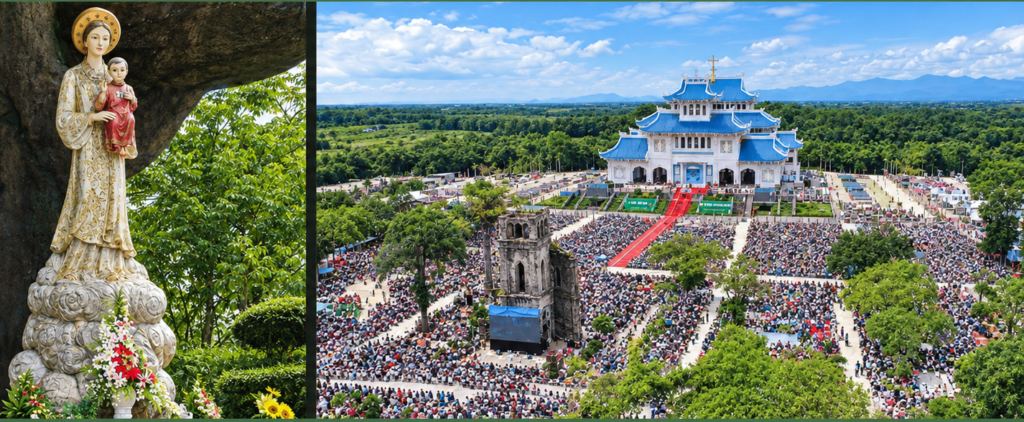
A basic chapel was erected at the site in 1820 once the initial wave of persecution subsided. However, subsequent rounds of anti-Christian movements destroyed the chapel later that century. A more robust, permanent tiled church was eventually completed and dedicated in 1901.
In 1961, the Catholic bishops of Vietnam designated La Vang as the National Sacred Marian Centre. Shortly after, Pope John XXIII officially elevated the sanctuary to the status of a minor basilica via papal decree. During the height of the Vietnam War in 1972, the basilica was completely destroyed by intense bombardment, leaving only the battle-scarred remnants of its old bell tower standing. In recent years, the local Church has undertaken massive construction projects to build a grand new basilica, hostels, and modern infrastructure to support millions of visiting faithful.
While Vatican has not officially canonized the event as a fully authenticated apparition, consecutive Popes have publicly recognized the historical weight and spiritual importance of the shrine. Pope John XXIII declared the site a minor basilica in 1962, and Pope John Paul II publicly recognized its profound importance for Vietnamese Catholics in 1988.
The Apocalypse or Revelation to John, the last book of the Bible, describes this scene: A great sign appeared in the sky, a woman clothed with the sun, with the moon under her feet, and on her head a crown of twelve stars (Rev 12:1).
In Rev 12, the Woman is relentlessly pursued by a dragon (representing Satan) and must flee into the wilderness, where God protects and sustains her. This mirrors the historical context of Our Lady of La Vang. During the fierce anti-Catholic persecutions of the Canh Thịnh reign, Vietnamese Catholics fled into the deep, perilous rainforest of La Vang. Just as the biblical Woman was comforted in the wilderness, Mary appeared to these hiding, sick, and frightened refugees praying the Rosary daily under a banyan tree, bringing them spiritual comfort and healing.
Modern and traditional statues of Our Lady of La Vang depict Mary wearing a traditional Vietnamese ao dai and a golden imperial headdress, khan van. In Catholic iconography, this royal crown and radiant attire directly mirror the “clothed with the sun” and the “crown” imagery of Revelation.
Rev 12 portrays the woman as crowned with stars who gives birth to a male child destined to rule the nations. In the La Vang apparition, Mary did not appear alone; she was seen holding the infant Jesus in her arms, flanked by two angels. By presenting her son to the persecuted community in the wilderness, the apparition visualizes the core message of Rev 12, the victory of Christ and his Mother over persecution and evil. Our Lady of La Vang is the great sign that appeared, called by the Rosary.